Nutrition
Perimenopause Diet: What to Eat in Each Cycle Phase
How perimenopause changes what your body needs, and eating with your cycle.
Food will not fix your hormones, and anyone promising that is selling something. But what you eat genuinely influences how your hormonal system runs: how steadily your energy holds, how hard PMS hits, how well you sleep. And in perimenopause the ground moves, so the way of eating that held in your 30s may not hold now. The goal is not a perfect diet. It is a steady, supportive baseline with a few phase-aware adjustments.
The principles that do most of the work
Four basics carry most of the benefit:
- Build meals around whole foods, quality protein, and healthy fats. Estrogen and progesterone are built from cholesterol, so long stretches of very low fat eating work against you. Protein matters separately, for holding muscle and for keeping a meal satisfying.
- Get enough fiber, roughly 25-30g daily.
- Drink to thirst and check the color. Pale straw is about right. The body-weight-in-ounces rule has nothing behind it, but mild dehydration does read as fatigue and headache, easily misattributed to hormones.
- Go gentle on sugar, alcohol, and caffeine, especially in the luteal phase. All three amplify the blood-sugar swings and sleep disruption that make premenstrual days harder, and sharper still in perimenopause.
If you change nothing else, these four move the needle.
What to eat in perimenopause
Perimenopause is not a quieter version of your cycle. The floor is moving, and that changes what your body needs from food. Perimenopause, Explained sets out what is shifting underneath.
The first thing to change is blood sugar. Estradiol supports insulin sensitivity, so as it turns erratic and eventually falls, glucose is handled less well. Muscle, where most of the glucose in a meal ends up, gets harder to hold from your 40s onward, and broken sleep lowers insulin sensitivity on its own, which is why a bad run of 3am waking shows up as cravings the next afternoon. The luteal week now arrives on a lower baseline, so eating complex carbohydrates regularly and not skipping meals stops being optional.
Protein is the second, and it deserves a number. Around 1.0 to 1.2g per kilogram of body weight a day is the range expert groups recommend for holding muscle and function as you age: roughly 65 to 80g for a woman of 65kg, spread across the day. In kitchen terms, a palm-sized portion of fish, eggs, meat, tofu or beans at every meal rather than the bulk of it at dinner.
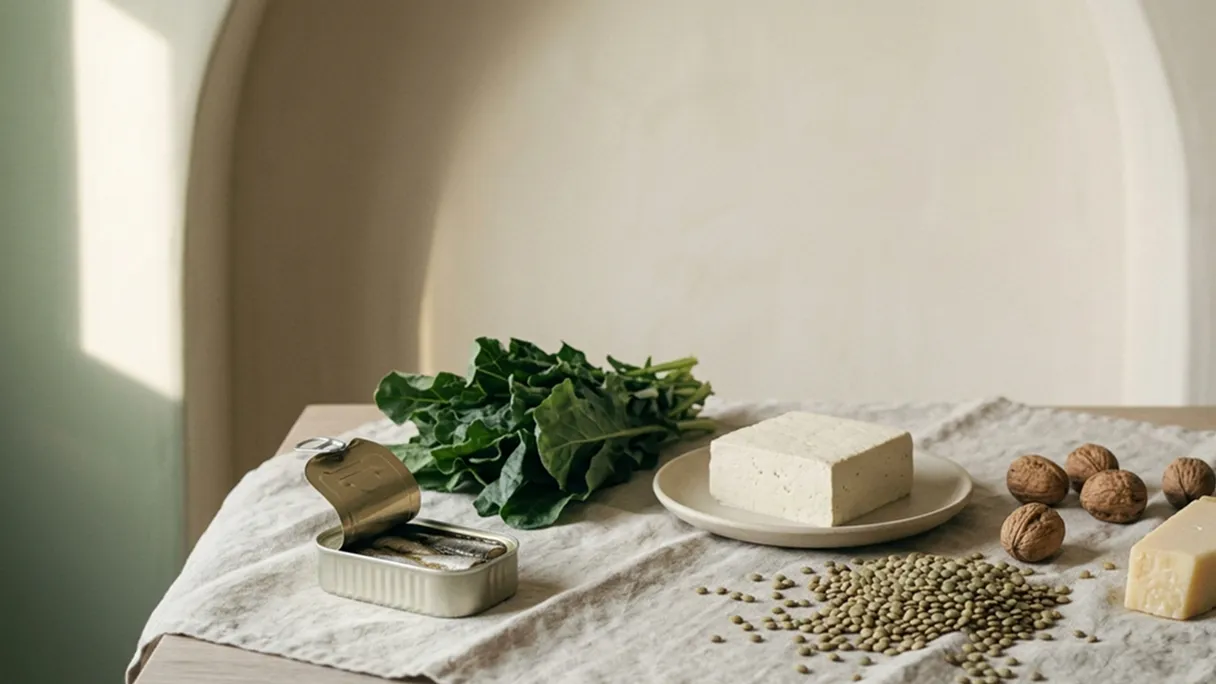
Bone is the one nobody mentions until something breaks. Bone loss starts about a year before your final period and does not slow until roughly two years after it, and this is the window where what you eat still counts. Aim for 700 to 1,200mg of calcium a day from food, a range that spans UK and US guidance: dairy, fortified plant milks, tinned sardines or salmon eaten with the bones, tofu set with calcium, dark leafy greens. Add 10 micrograms of vitamin D daily as a supplement through the autumn and winter, because food and winter daylight will not reliably provide it.
Then the phytoestrogen question, where the marketing runs ahead of the evidence. Estradiol does not fall in a tidy line here, it swings, sometimes higher than it ever ran in your 30s, before settling low. Of the plant compounds that act weakly on estrogen receptors, soy isoflavones, from edamame, tofu and tempeh, are the ones with any signal, and even there the Cochrane review found no conclusive evidence that phytoestrogen supplements reduce hot flashes. Flaxseed did no better than placebo for hot flashes in a randomized trial, despite its reputation. Ordinary amounts of soy are fine for most women, but if you have had breast cancer or take tamoxifen, raise concentrated soy or isoflavone supplements with your oncology team, not with a website.
Eating with your phases
Once the basics are steady, you can layer in phase awareness. None of this is a rulebook; think of it as cooperating with the weather.
Menstrual phase. Your body is doing repair work and losing iron. Lean into iron-rich foods like leafy greens, legumes, and red meat if you eat it, alongside warming meals: soups, stews, cooked vegetables. Comfort is not a failure here; it is appropriate. But be honest about the scale: if your periods have become heavy, food will not correct that. Ask for ferritin by name rather than a full blood count alone, because iron deficiency precedes anemia, so your stores can be low while your count reads normal. Heavy periods in perimenopause covers what else to ask for.
Follicular phase. Rising estrogen usually brings energy and a lighter appetite. Fresh, lighter foods tend to feel right: salads, lean proteins, fermented foods for gut support.
Ovulation phase. Estrogen peaks. Fiber-rich vegetables and antioxidant-rich fruits support the body in processing that peak, and lighter grains keep energy steady through your most social days.
Luteal phase. This is where nutrition earns its keep. Resting metabolic rate runs slightly higher in the luteal phase, and cravings are real physiology rather than weak will. Favor complex carbohydrates that release slowly, magnesium-rich foods like dark chocolate, nuts, and seeds, and B-vitamin sources like eggs and whole grains. Eating regularly matters more this week than any other: long gaps between meals plus falling hormones is the recipe for the 4pm crash and the short fuse that follows it.
The nutrients worth knowing by name
A handful come up again and again:
- Magnesium: muscle relaxation, sleep quality, and mood. The evidence that supplementing changes how you feel is thinner than the marketing suggests.
- Omega-3 fatty acids: inflammation, and a food-first source of the fats hormones are built from.
- Vitamin D: bone, immune function and mood. 10 micrograms daily, as above.
- B vitamins: energy production and nervous system support.
- Zinc: skin, immune health, and hormone production.
Food first is the sensible default, and supplements fill genuine gaps. If you take them, tracking them alongside how you feel is the only honest way to know whether they do anything for you.
Watching it work
The tricky thing about nutrition is the lag: what you eat on Tuesday shows up in how you feel on Wednesday or Thursday, and the effect differs by phase. That connection is nearly impossible to see in your head and surprisingly easy to see on paper. A simple daily note of what you ate and how you felt, lined up against your cycle, will teach you more about your body in a month than any general article can, including this one.
Nobody is asking you to eat perfectly through a transition that already takes plenty from you, only to give a body doing unfamiliar work the raw materials, and then notice what changes. If you are not sure where you are in it, a perimenopause self-assessment will show you whether your symptoms cluster.
This article is for educational purposes and is not medical advice. Talk to a healthcare provider before making significant dietary changes or starting supplements, especially if you have a medical condition or take medication. Do not start iron before being tested, and get bleeding that soaks a pad every hour, or any bleeding after twelve months without a period, seen rather than eaten around.
Keep reading